Sofia's laptop
Hot MilkSofia Papastergiadis’s laptop is both a practical store of her unfinished academic life and the object through which she measures her sense of being broken. When it falls screen-first onto the concrete floor of a beach bar in Almería, the computer still works, but its shattered display makes visible how closely Sofia has tied her own identity to the life held inside it: the damaged screen is not merely a repair problem but a fracture she recognizes in herself.
The shattered screen and its miniature universe
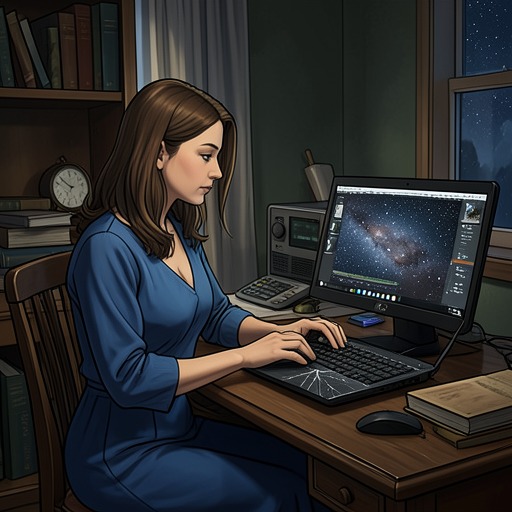
The laptop slips from beneath Sofia’s arm and out of a black rubber sheath shaped like an envelope. It lands face down on the concrete. The digital page is shattered, though the machine remains usable. Sofia thinks of the computer as containing her whole life and knowing her better than anyone else. That conviction gives the accident unusual weight: the damage seems to reach beyond a device and into the private record on which she depends to recognize herself.
The screen saver makes that record cosmic in scale and ordinary in manufacture. It shows a purple night crowded with stars, constellations, and the Milky Way. Sofia remembers that her mother taught her to write the Milky Way in Greek and told her about Aristotle gazing at the luminous circle. Against the age of the oldest stars, about thirteen billion years, the stars on the screen are only two years old and made in China. The contrast turns the screen into a compact meeting place for family instruction, classical reference, astronomical time, and mass production. Now that manufactured universe is shattered too.
Sofia often gazes at the star field and feels herself float out of time. After the fall, she imagines that the real night sky and sea might offer an alternative to the broken image on the laptop, but jellyfish make her nervous. The computer’s screen therefore belongs to a recurring tension between mediated distance and bodily exposure: it offers a surface on which Sofia can drift into thought, while the beach brings her back to heat, injury, and the immediate limits of her body.
A repository of stalled work
The laptop contains the unfinished thesis for Sofia’s doctorate, stored in a digital file behind the screen saver. That file condenses a long retreat from the future she once expected. Her academic ambition began when she left her mother alone to pick pears in the garden of their East London home as she went to university. Sofia earned a first-class degree and continued to a master’s, but her doctoral work ended when Rose became ill and Sofia abandoned her Ph.D. The thesis remains present but uncompleted: not erased, yet inaccessible behind the image of a universe whose surface has been broken.
That stalled file sits against Sofia’s less prestigious working life. She works in the Coffee House and regards herself as a failure, even though she would rather do that work than research consumer preferences for washing machines. Many of her fellow anthropology students became corporate ethnographers. Sofia can see that market research also studies culture—how people live and divide up household work—but its purpose is ultimately to sell a product. The laptop’s stored thesis thus preserves more than a qualification she did not finish: it holds the unresolved distance between the anthropological work she once pursued and the employment and caregiving that now organize her days.
The computer’s broken condition makes this unresolved future practical as well as symbolic. Sofia hears of a cybercafé in the next town where minor faults are sometimes repaired, but a replacement screen would have to be ordered and would take a month to arrive. She cannot know whether she will still be in Spain by then, because that depends on Rose’s illness. Repair time is measured against the uncertain duration of her stay and the demands of her mother’s care. The laptop waits for a future that Sofia cannot confidently schedule.
A screen inside the work of care
The computer remains in use even after its damage. During a recorded consultation in the physiotherapy room, Sofia sits uneasily in a corner with the laptop on her knees. Dr Gómez has asked her to attend, and she has agreed on the understanding that, apart from Tuesdays, she will be free for the rest of Rose’s treatment. In practice, Sofia experiences this freedom as something she pays for by listening to her mother’s words. The laptop is physically with her, but it cannot remove her from the clinic’s family and medical obligations.
As Rose speaks about her parents, Sofia puts on headphones and looks at YouTube on the shattered screen. The device provides a small retreat from a family history she knows but does not want to feel connected to. At the same time, the unfinished doctoral thesis remains behind the screen’s digital constellations. Work, distraction, and avoidance occupy the same damaged surface: the computer holds the research Sofia left unfinished while offering a place to look away from the story unfolding beside her.
Sofia’s dependence on the device also meets the language of dependence within the family. At home, Rose calls for water, and Sofia brings it from the refrigerator, from outside it, or from a kettle where it has been boiled and left to cool; none is reliably the right kind. This routine places Sofia’s attention under continual demand. Her laptop may contain what she calls her life, but it does not free her from the immediate, repeated tasks through which that life is being spent.
Veil, memory, and the body
The laptop becomes an instrument of concealment when Rose describes Sofia as idle and living off her mother. Sofia acknowledges that her body has shifted between thinness and other sizes throughout her life, and says that her mother’s words act as a mirror while the laptop is a veil of shame. The contrast is exact: the mother’s judgment reflects an image Sofia finds painful, while the screen gives her somewhere to hide. The damaged device is therefore not simply an emblem of lost ambition; it remains useful to Sofia as a barrier between herself and another person’s assessment of her.
The novel also places that screen-bound self-description beside changes in bodily movement. At the clinic, Sofia walks in step with Rose, describing her legs as her mother’s legs; later, she finds herself limping even when she is not beside her and understands the movement as memory. These episodes show a life shaped by bodily rhythms that do not follow a clean division between her mother’s needs and her own. In that context, the laptop’s stalled file and its unreliable screen are material counterparts to an interrupted sense of time, not evidence that Sofia has simply stopped moving forward.
Near the end, Sofia sees Rose, aged sixty-four, walking alone along the shore in a sunflower-patterned dress with her hat in her hand. Sofia does not run to her; she swims away, and later finds Rose’s footprints in the sand, marking a rectangle around the first two with a stick. The scene offers a striking counterpoint to the laptop’s digital archive. One holds an unfinished account behind a shattered surface; the other leaves a temporary, physical trace that Sofia chooses to preserve. The contrast does not resolve Sofia’s uncertainty about her work or her care for Rose, but it gives the story another way to register what a record can hold: not only a life stored on a screen, but the visible passage of a body across the ground.